Wisdom Shows the Path, Viriya Walks It

A Continuation from the Previous Article
In the previous article, we explored Paññā, the fourth of the Ten Pāramīs. We understood that wisdom is not about knowing more but about seeing more clearly. We discovered that we do not suffer merely because life is difficult. We suffer because we misunderstand life. Wisdom shows us the direction. It helps us understand what is wholesome and what is unwholesome, what leads to suffering and what leads to freedom. But an important question arises here. Is understanding alone enough? Can simply seeing the path take us to the destination? No. Between seeing the path and walking it, a bridge is needed.
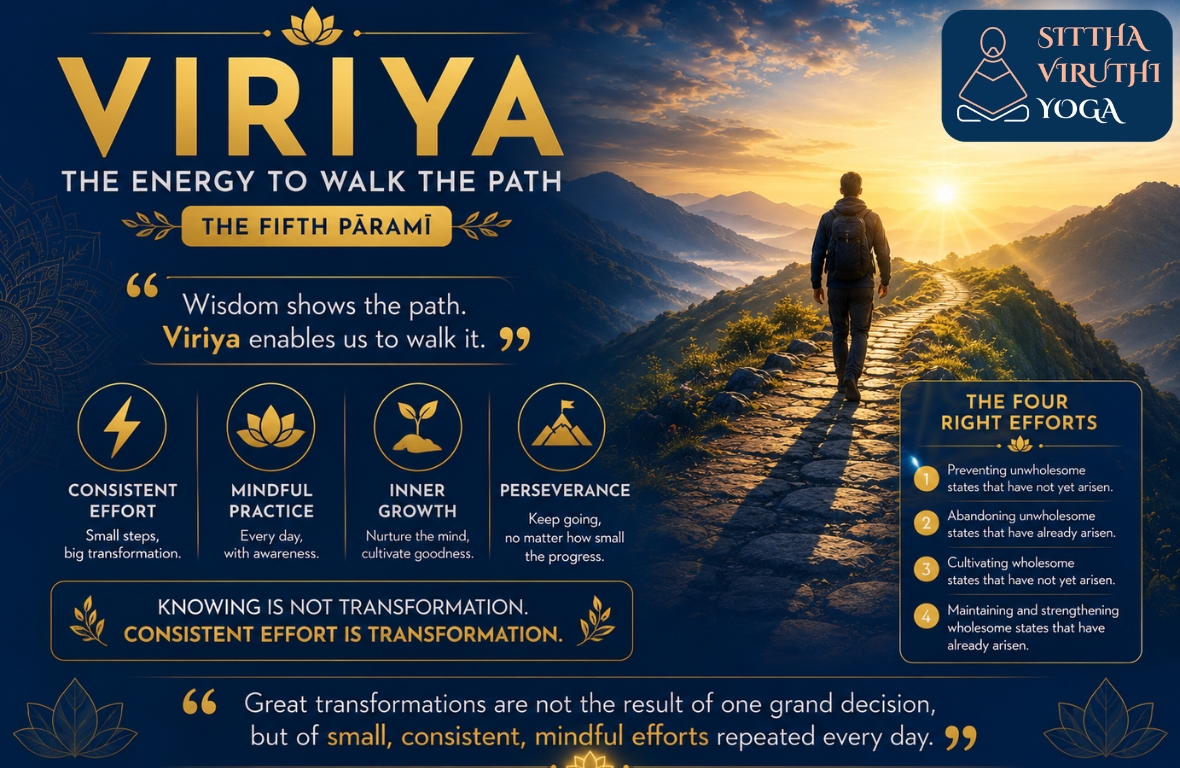
That bridge is the fifth Pāramī: Viriya — Energy, Effort, and Perseverance.
What Is Viriya?
Many people understand Viriya as hard work, ambition, or the drive to achieve success. But in the context of the Pāramīs, Viriya is much deeper. Viriya is not merely the energy to work. It is the steady, mindful, and purposeful effort required for inner transformation. Viriya is not a burst of enthusiasm that lasts for a day. It is not motivation that lasts for a week. It is the inner energy that enables us to keep moving forward. Many people know what they should do. Yet they struggle to do it consistently. This is where Viriya becomes essential.
Simply put: Wisdom shows the path. Viriya enables us to walk it.Why Is Viriya Important?
A person may know that exercise is beneficial. They may know that anger damages relationships. They may know that meditation calms the mind. They may know that healthy food supports well-being. But does knowledge alone transform life? No. Many of life's problems do not arise merely from ignorance. They arise because we fail to practice what we already know. That is why there is often a gap between understanding and living. Viriya bridges that gap.
One Piece of Advice, Two Different Lives
Imagine a doctor speaking to two patients. He tells them: "If you continue your current lifestyle, serious health problems may develop in the future." Both patients understand. Both nod their heads. Both know what needs to be done. The first person begins changing his habits immediately. Daily walking. Healthier food. Regular sleep. Small but consistent improvements. The second person also decides to change. But he postpones it until tomorrow. Then next week. Then next month. Five years later, their lives look completely different. The difference was not knowledge. The difference was effort. This is Viriya.
Knowing is not transformation. Consistent effort is transformation.The Lesson of a Water Drop
A young boy was walking through a village with his grandfather. Along the way, he noticed a large stone with a small hollow in it. Curious, he asked: "Grandfather, how did this hole form in such a hard rock?" His grandfather smiled and replied: "For many years, raindrops kept falling on the same spot." The boy was surprised. "Can a single drop of water really do that?" The grandfather answered: "One drop cannot. But thousands of drops falling steadily over time can accomplish what seems impossible." Inner growth is much the same. One day of meditation will not create profound transformation. One day of controlling anger will not change a life. One day of wholesome thinking will not produce wisdom. But small, mindful efforts repeated day after day gradually transform the mind. In the end, those tiny efforts create extraordinary changes. Viriya is not about performing great heroic acts in a single day. It is about falling steadily in the right direction, like a drop of water.
The Deeper Perspective of the Abhidhamma
The Abhidhamma emphasizes an important truth. Wholesome mental states do not sustain themselves automatically. Likewise, unwholesome tendencies do not disappear on their own. Therefore, mental development requires conscious effort.
The Buddha described this through the Four Right Efforts:
- Preventing unwholesome states that have not yet arisen.
- Abandoning unwholesome states that have already arisen.
- Cultivating wholesome states that have not yet arisen.
- Maintaining and strengthening wholesome states that have already arisen.
This is the deeper meaning of Viriya. Viriya is not merely effort. It is intelligent effort directed toward the training and transformation of the mind.
The Farmer's Lesson
A farmer plants a seed. He cannot force the seed to grow. That is nature's work. But there are things he must do. He must prepare the soil. He must water the field. He must remove weeds. He must protect the crop. And he must continue doing these things. Not for a day. Not for a week. But until the harvest arrives. Inner transformation works in the same way. Wisdom chooses the seed. Viriya cares for it. Without Viriya, talent does not develop. Without Viriya, good intentions produce no results. Without Viriya, transformation never occurs.
How Viriya Transforms Us
Consistent effort gradually changes a person. It develops discipline. It develops determination. It develops confidence. It develops resilience. Most importantly, it weakens the grip of old habits and conditioning. Every wholesome effort creates a new direction. Every mindful action creates a new mental pathway. Transformation does not happen overnight. But daily efforts accumulate and eventually create profound change.
Conclusion
Dāna taught us how to let go. Sīla taught us how to live. Nekkhamma taught us freedom from attachment. Paññā taught us how to see clearly. Viriya teaches us how to act. Because: Seeing the path is important. Walking the path creates transformation. And: The distance between seeing the path and reaching the destination is crossed by Viriya. Great transformations are rarely the result of one grand decision. They are usually the result of small, consistent, and mindful efforts repeated over time. That is the power of Viriya.
In the Next Article
Once we begin making effort, a new challenge emerges. Transformation does not happen immediately. Results may take time. People may misunderstand us. Obstacles may appear. At times, we may become discouraged. In those moments, effort alone is not enough. We also need patience. In the next article, we will explore Khanti — the sixth Pāramī, the perfection of patience, endurance, forbearance, and the strength to remain steady in the face of difficulty.