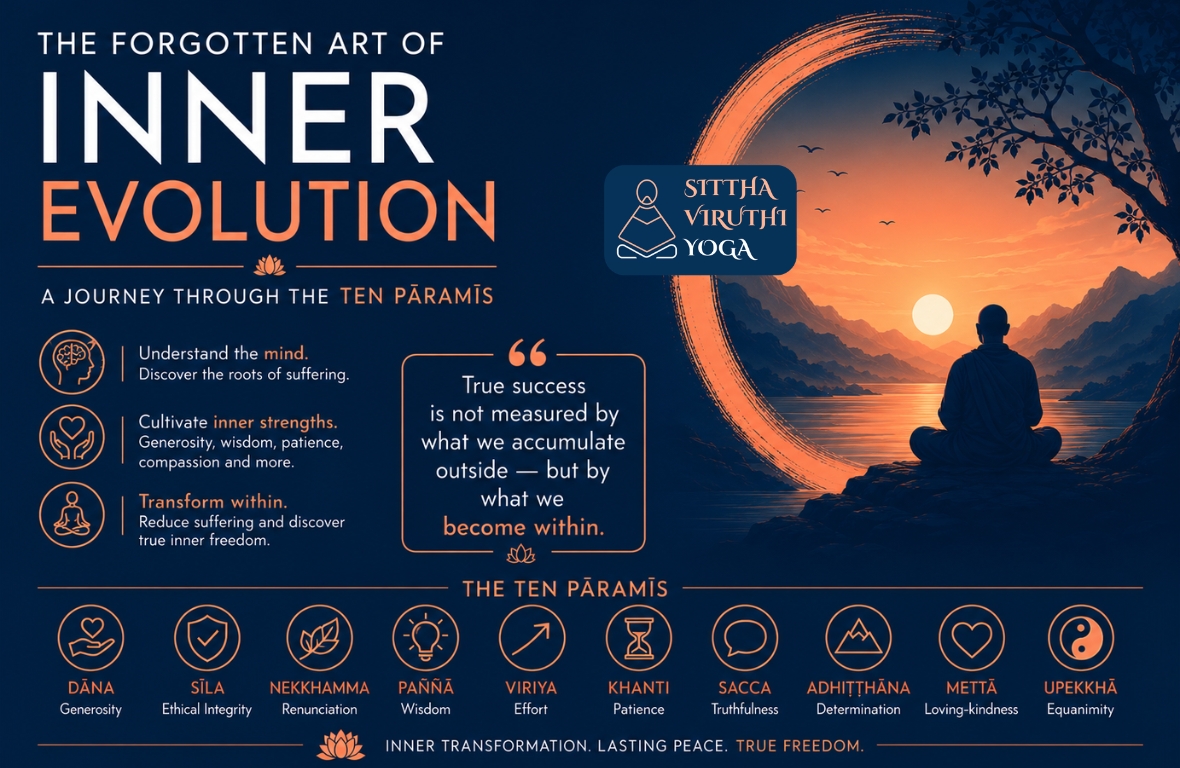
The Forgotten Art of Inner Evolution: A Journey Through the Ten Pāramīs

Human beings have achieved extraordinary things. We have built civilizations, industries, technologies, transportation systems, and artificial intelligence. We can communicate across continents within seconds. We can access oceans of information from the palm of our hands. We have learned to cure diseases, explore space, and automate countless aspects of life.
Yet inwardly, humanity still struggles.- Behind modern comfort, there is often anxiety.
- Behind entertainment, there is restlessness.
- Behind achievement, there is exhaustion.
- Behind social connection, there is loneliness.
- Behind confidence, there is fear.
- Behind success, there is still dissatisfaction.
A person may possess education, wealth, status, and recognition — yet remain deeply disturbed within. Why? Because external progress alone cannot resolve inner suffering. Modern society has become highly skilled at improving the conditions of life, but not necessarily the quality of consciousness that lives through those conditions. We are taught how to compete, achieve, acquire, and survive. Rarely are we taught how to understand the mind itself.
Very few people are taught:- How craving shapes suffering
- how anger poisons the heart
- How comparison destroys peace
- How attachment creates fear
- How ego generates conflict
- How unconscious habits control behavior
- How the restless mind keeps searching endlessly outside while remaining disconnected within.
As a result, human beings often become externally developed but internally fragmented.
One part of the mind seeks pleasure.- Another seeks validation.
- Another seeks control.
- Another fears rejection.
- Another clings to identity.
- Another escapes into distraction.
And silently, beneath all this movement, many people carry an unspoken exhaustion. Not merely physical exhaustion — but psychological exhaustion.
The exhaustion of constantly reacting.- Constantly desiring.
- Constantly comparing.
- Constantly defending oneself.
- Constantly seeking fulfillment from changing external conditions.
The tragedy is not that human beings suffer. The tragedy is that most people do not deeply understand why they suffer. They try to solve inner emptiness through external accumulation. They try to heal emotional instability through stimulation and distraction. They seek peace without understanding the structure of the mind that disturbs peace. But unless the roots within are understood, suffering simply changes form. This is where the wisdom of the Buddha becomes profoundly relevant — even today. The Buddha did not merely ask: “How can life become more comfortable?”
He asked a far deeper question: “Why does the human mind suffer even when conditions appear favorable?” And more importantly: “Is it possible for the human mind to become truly free?” His approach was revolutionary because he did not place the primary cause of suffering outside the individual.
He pointed inward. Not inward in a mystical sense — but in an observational sense. He examined desire, attachment, fear, anger, ego, craving, ignorance, emotional reactions, and the countless mental patterns that condition human experience. And through deep insight, he discovered something extraordinary: Human suffering is not merely caused by circumstances. It is deeply connected to the way the mind perceives, reacts, clings, resists, and identifies.
This understanding gave rise to a path of inner transformation.- Not blind belief.
- Not ritualistic worship.
- Not moral policing.
But systematic inner refinement. Among the many profound teachings he offered, one of the most beautiful and transformative frameworks is the cultivation of the Ten Pāramīs — often translated as the Perfections. But the word “perfection” can sometimes be misunderstood. The Pāramīs are not about becoming morally superior or appearing spiritually impressive in the eyes of society. A Pāramī is a deeply cultivated quality of character that gradually transforms the mind and reduces suffering. These qualities are not commandments imposed from outside, but inner strengths consciously developed through awareness, reflection, practice, and lived experience. In Buddhism, the Pāramīs are considered essential qualities that help a human being evolve from unconscious and reactive living toward wisdom, compassion, balance, freedom, and awakening. Each Pāramī addresses a different layer of human suffering and psychological bondage.
One weakens greed.- Another stabilizes conduct.
- Another softens anger.
- Another develops wisdom.
- Another strengthens resilience.
- Another cultivates truthfulness.
- Another deepens compassion.
- Another brings balance amidst chaos.
Together, they slowly transform the structure of consciousness itself.
The Ten Pāramīs are:
- 1. Dāna Pāramī (Generosity)
- 2. Sīla Pāramī (Ethical Conduct)
- 3. Nekkhamma Pāramī (Renunciation)
- 4. Paññā Pāramī (Wisdom)
- 5. Viriya Pāramī (Energy and Perseverance)
- 6. Khanti Pāramī (Patience and Forbearance)
- 7. Sacca Pāramī (Truthfulness)
- 8. Adhiṭṭhāna Pāramī (Determination and Resolve)
- 9. Mettā Pāramī (Loving-kindness and Compassion)
- 10. Upekkhā Pāramī (Equanimity and Balance)
These are not merely religious ideals meant only for monks or spiritual seekers. They are deeply human capacities. In fact, every emotionally healthy, psychologically mature, and inwardly peaceful human being embodies these qualities to some degree — whether consciously or unconsciously.
- A person without generosity becomes imprisoned by possessiveness.
- A person without ethical clarity creates suffering for oneself and others.
- A person without patience becomes a slave to reactions.
- A person without wisdom gets lost in illusion.
- A person without equanimity gets shaken by every changing circumstance.
The Pāramīs help us see that true transformation is not about controlling the world outside. It is about understanding and refining the world within. This path is not instant. Human conditioning has been built over years — sometimes lifetimes — of fear, craving, attachment, insecurity, and unconscious reactions. Therefore inner transformation requires gradual cultivation. Just as a seed slowly becomes a tree, consciousness too evolves through sustained refinement. The beauty of the Pāramīs is that they do not demand perfection from the beginning.
They invite practice.- Every moment of generosity weakens selfishness.
- Every moment of awareness weakens unconsciousness.
- Every moment of patience weakens anger.
- Every moment of truthfulness weakens inner fragmentation.
- React less.
- Cling less.
- Fear less.
And perhaps for the first time, one begins to experience a different kind of freedom — a freedom not dependent on external conditions. This article marks the beginning of a ten-week journey through the Ten Pāramīs. Each week, we will explore one Pāramī in depth — not merely as an ancient spiritual teaching, but as a living psychological truth deeply relevant to modern life. We will examine how each quality influences the mind, shapes human relationships, affects emotional well-being, and contributes to inner freedom. Because the Pāramīs are not abstract ideals preserved in ancient texts. They are practical tools for transforming human consciousness. Modern civilization has mastered the art of outer expansion. But humanity still urgently needs inner evolution.
Without inner maturity:
- Technology becomes dangerous,
- Knowledge becomes manipulative,
- Success becomes empty,
- Relationships become fragile, and
- Pleasure becomes addictive.
The real crisis of humanity may not merely be economic, political, or technological. It may fundamentally be a crisis of consciousness. The Pāramīs offer a timeless response to this crisis. They remind us that peace is not created merely by changing circumstances, but by transforming the mind that experiences those circumstances. Perhaps the deepest purpose of life is not merely to achieve more, possess more, or become more important in the eyes of society. Perhaps the deeper purpose of life is to awaken. To understand oneself deeply. To become inwardly free. To evolve beyond unconscious suffering. And maybe true success is not measured by what we accumulate outside — but by what we become within.