Sīla: The Foundation of Inner Peace A Continuation from the Previous Article

In the previous article, we explored Dāna, the first of the Ten Pāramīs. We saw that Dāna is not merely about giving material things. It is an inner practice that loosens the grip of attachment and possessiveness. We also understood that clinging creates suffering, while letting go creates freedom. Yet an important question still remains. Once we begin to loosen our attachments, how should we live? The answer to that question is found in the second Pāramī: Sīla.
What Is Sīla?
Vethathiri Maharishi defined ethical conduct in a remarkably simple yet profound way: "Ethics is maintaining thoughts, words, and actions that do not cause suffering to oneself or others, either in the present or in the future, and that do not harm life or the body."
There is deep wisdom in this definition. It does not view ethics as a religious commandment. Rather, it views ethics as a way of living that does not create suffering. Does a thought cause pain to ourselves or others? Does a word create harm now or in the future? Does an action damage life or well-being? To live with this kind of awareness is what he calls ethical conduct. This beautifully captures the practical dimension of Sīla.
But the Buddha’s understanding of the Sīla Pāramī goes one step deeper. Sīla is not merely a way of living that avoids creating suffering. It is also a way of living that protects the peace, clarity, and balance of the mind. Every thought, word, and action creates not only external consequences but also internal consequences.
Some actions make the mind lighter. Some make it heavier. Some strengthen clarity. Some create confusion. Therefore, Sīla is not merely about avoiding wrongdoing. It is about living in a way that supports peace.
Simply put: Sīla is avoiding the creation of suffering and protecting the peace of the mind.
Why is Sīla Important?
Human beings are constantly searching for peace. Some seek it in wealth. Some seek it in relationships. Some seek it in fame. Some seek it in achievement. Some seek it through spiritual practices. Yet we often overlook a strange truth. While searching for peace, we are simultaneously disturbing it. Can a person deceive others and still expect inner peace? Can a person repeatedly hurt others and still experience tranquility? Can someone live amidst dishonesty, manipulation, selfishness, and irresponsibility and still enjoy genuine inner harmony? These are not merely moral questions. They are psychological questions. Because our actions do not simply affect the world around us. They shape the quality of our own minds.
What Happens When Sīla Is Absent?
The words we speak. The decisions we make. The relationships we maintain. The actions we perform. All of them leave an imprint on the mind. When we hurt someone in anger, the wound is not limited to them. Our own minds are affected as well. When we lie, it is not only others who are deceived. The clarity of our own minds is weakened. When we act out of greed or selfishness, it is not only others who suffer. Our inner balance is disturbed too. This is why the Buddha did not see Sīla as a punishment. He saw it as protection. Before protecting others, Sīla protects us. Every unwholesome action first disturbs the mind. Then it disturbs life. Eventually, it disturbs relationships.
How Does Sīla Transform Us?
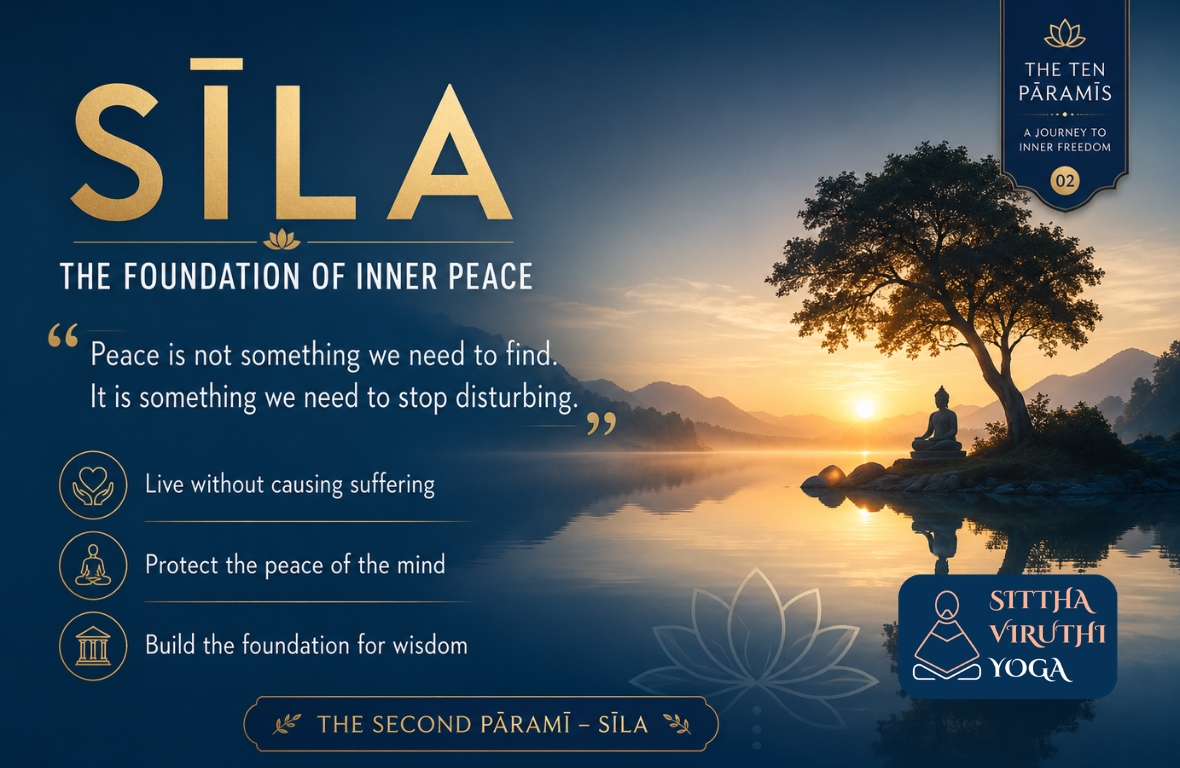
Imagine a calm lake. When its surface is still, it reflects the sky clearly. But what happens if someone continually throws stones into it? Ripples arise. The reflection becomes distorted. The mind functions in the same way. By nature, the mind has the capacity for clarity and peace. Yet through our actions, words, and intentions, we keep throwing stones into it. Then we wonder why peace seems so difficult to find.
Sīla reveals a simple truth: Peace is not something we need to find. It is something we need to stop disturbing.
When a house is built, the foundation comes first. If the foundation is weak, no matter how beautiful the structure, it will not endure. Likewise, Sīla is the foundation for meditation, wisdom, spiritual growth, and inner transformation. Without Sīla, the mind cannot become stable. Without stability, deep wisdom cannot arise. Sīla gradually frees us from many forms of inner slavery. It frees us from the domination of greed. It frees us from the domination of anger. It frees us from the domination of dishonesty. It simplifies life. It purifies relationships. It lightens the mind. It softens the heart. And it prepares the ground for lasting inner peace.
Conclusion
Dāna taught us how to let go. Sīla teaches us how to live. Dāna loosens the grip of “mine.” Sīla answers the question: “How should I live?” Both serve the same purpose. Inner freedom.
Because: The way we live shapes the way we feel.
If we desire inner peace, we must live in ways that support peace. If we desire inner clarity, we must live in ways that support clarity. If we desire inner freedom, we must live in ways that support freedom.
Because: A disturbed life cannot produce a peaceful mind. Or, more deeply: Peace is not a place we travel to. It is our natural state when we stop disturbing it.
In the Next Article
Dāna taught us to loosen our attachments. Sīla taught us how to live wisely. Yet another challenge remains. Even when we live ethically, the mind continues to crave. More wealth. More comfort. More recognition. More experiences. Why is the mind never satisfied? Why does it rush toward the next desire as soon as one desire is fulfilled? Is it possible to become free from this endless cycle of wanting? In the next article, we will explore the third Pāramī, Nekkhamma — the art of inner freedom from endless craving and compulsive wanting.