Paññā: The Wisdom of Seeing Things as They Truly Are

A Continuation from the Previous Article
In the previous article, we explored Nekkhamma, the third of the Ten Pāramīs. We saw that Nekkhamma is not about running away from life, rejecting relationships, or despising possessions. Rather, it is freedom from the mental slavery created by attachment. The problem is not what we have. The problem is what has hold of us. As attachment begins to loosen, something remarkable happens. The mind becomes quieter. The noise of craving begins to fade. And when the mind becomes quieter, it gains a new ability. It begins to see clearly. This brings us to the fourth Pāramī: Paññā — Wisdom.
What Is Paññā?
Many people confuse wisdom with knowledge. Being highly educated. Having vast amounts of information. Knowing many facts. These are often mistaken for wisdom. But life teaches us otherwise. Highly educated people can still become angry. Intelligent people can still be trapped by greed. Brilliant minds can still be overwhelmed by fear. A mind filled with information can still live in confusion. Because knowledge and wisdom are not the same.
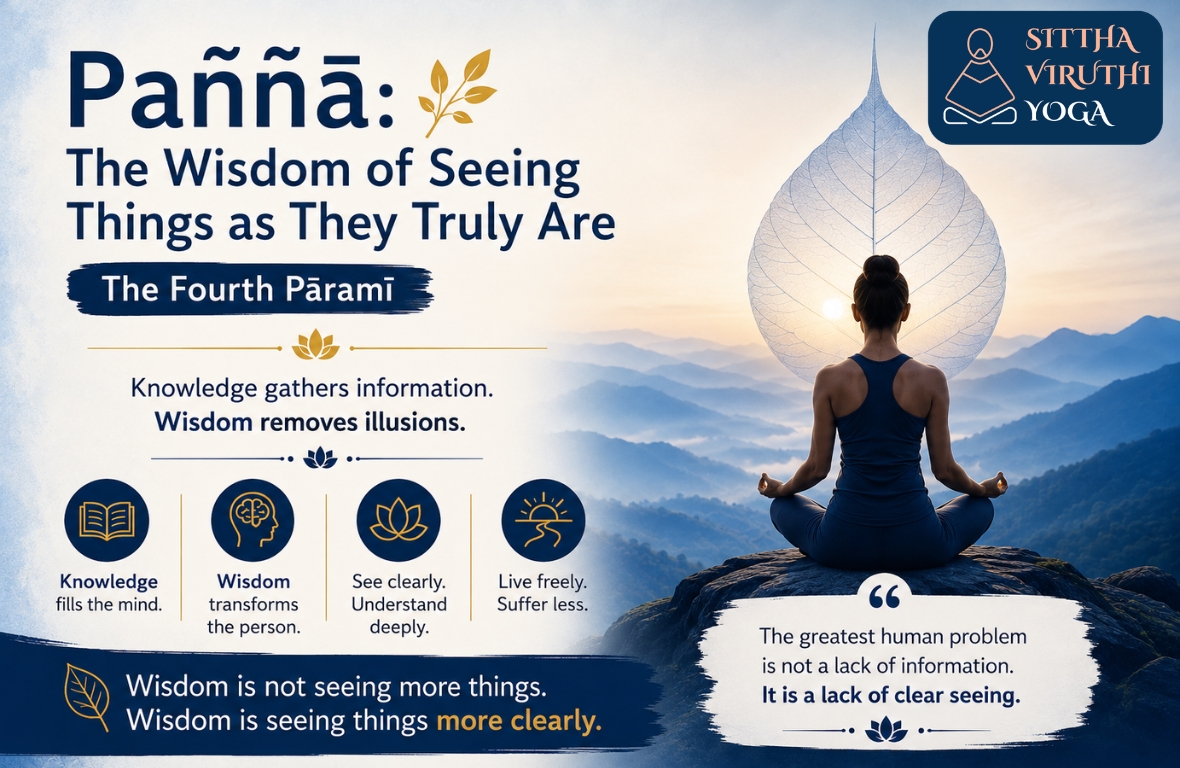
Knowledge may fill the mind. Wisdom transforms the person.In the Buddha's teaching, Paññā does not mean knowing more. It means seeing more clearly. It is the ability to see reality as it truly is, rather than as we wish it to be. Seeing impermanence as impermanence. Seeing suffering as suffering. Seeing attachment as attachment. Seeing craving as craving. Seeing causes as causes. Seeing effects as effects.
Simply put: Paññā is the ability to see things as they truly are.Why Is Wisdom Important?
Most people believe that suffering is created by circumstances. The Buddha's discovery was far deeper. According to the Abhidhamma, suffering is often created not by circumstances themselves, but by our misunderstanding of them. In a constantly changing world, we expect permanence. In an uncertain life, we expect certainty. In temporary experiences, we seek lasting happiness. We try to control what is ultimately beyond our control. We seek permanent security today in things that may change tomorrow. And when life fails to meet these expectations, suffering arises. The problem is not life itself. The problem lies in our understanding of life.
One Event, Two People
Imagine two employees working in the same company. Both lose their jobs on the very same day. The first person immediately begins thinking: "My life is over." "I am a failure." "I have no future." Within days, he becomes trapped in anxiety, fear, anger, and despair. The second person loses the same job. He experiences the same pain. But he sees it differently. "This is difficult." "But life is always changing." "Perhaps this is the doorway to a new opportunity." A few months later, he has begun moving in a new direction. Now consider the question: Did the two people experience different events? No. The same thing happened to both. Then why did one person break down while the other grew? The difference was not the event. The difference was their understanding of the event. This is Paññā.
The event itself is not the suffering. Our interpretation of the event often becomes the suffering.Wisdom does not magically remove painful experiences. It helps us see them clearly. And when we see them clearly, life begins to mature us rather than break us.
The Deeper Analysis of the Abhidhamma
One of the greatest strengths of the Abhidhamma is its detailed analysis of the mind. The Abhidhamma speaks of three unwholesome roots:
- Lobha (greed)
- Dosa (hatred)
- Moha (delusion)
Among these three, Moha is the most fundamental. Greed grows because of misunderstanding. Hatred grows because of misunderstanding. Behind much of human suffering lies a distorted way of seeing. We mistake the impermanent for something permanent. We mistake the changing for something stable. We mistake what is dependent and conditioned for something independent and lasting. From these misunderstandings arises attachment. Attachment gives rise to fear. Fear gives rise to suffering. The Abhidhamma points to another profound truth: Nothing in this world remains fixed. Every thought arises and passes away. Every feeling arises and passes away. Every experience arises and passes away. Yet the mind tries to hold on to these fleeting phenomena as though they were permanent. The moment this illusion begins to dissolve, wisdom begins to arise.
How Wisdom Transforms Us
Wisdom does not necessarily change the world. It changes our relationship with the world. A wise person still experiences loss. Success and failure still occur. Praise and blame still arise. Pleasure and pain still come and go. But wisdom changes the way these experiences are understood. When understanding changes, reactions change. When reactions change, suffering decreases. A wise person becomes less fearful. Because they understand that change is part of life. They become less attached. Because they understand that nothing is permanent. They become less judgmental. Because they understand that every person is shaped by countless causes and conditions. Gradually, a quiet stability emerges. Not because life has become easier. But because life has become clearer.
The Mirror and the Dust
Imagine trying to see your reflection in a mirror covered with dust. The image appears distorted. The problem is not the mirror. The problem is the dust. The mind is much the same. Reality is always present before us. But our perception is often covered by layers of craving, fear, aversion, attachment, prejudice, and conditioning. Wisdom does not create a new reality. It removes the dust. The clearer the mind becomes, the more clearly reality is seen. And the more clearly reality is seen, the less unnecessary suffering is created.
Conclusion
Dāna taught us how to let go. Sīla taught us how to live. Nekkhamma taught us freedom from endless wanting. Paññā teaches us how to see. Because the greatest human problem is not a lack of information. It is a lack of clear seeing. We do not suffer merely because life is difficult. We suffer because we misunderstand life. Therefore:
Knowledge gathers information. Wisdom removes illusions.And: Wisdom is not seeing more things. Wisdom is seeing things more clearly. As clarity grows, the foundations of suffering begin to weaken. The mind becomes lighter. The heart becomes freer. And life begins to reveal itself in an entirely new way.
In the Next Article
Seeing clearly is essential. But seeing alone is not enough. A person may know what is right and still fail to do it. A person may see the path and still lack the strength to walk it. Wisdom shows us the direction. Effort moves us forward. In the next article, we will explore Viriya — the Pāramī of energy, perseverance, determination, and courageous effort, the force that transforms understanding into lived reality.