Nekkhamma: Freedom from the Endless Need for More

A Continuation from the Previous Article
In the previous article, we explored Sīla, the second of the Ten Pāramīs. We saw that Sīla is not merely a set of moral rules or religious commandments. It is a way of living that avoids creating unnecessary suffering for oneself and others while protecting the peace, clarity, and balance of the mind.
- Yet an important question still remains.
- A person may be generous.
- A person may live ethically.
- And yet, is the mind truly at peace?
- Not necessarily.
Because even when we live well, the mind often continues to chase something more.
- More wealth.
- More comfort.
- More recognition.
- More experiences.
- More success.
This restless movement of the mind—the constant feeling that something more is needed—is one of the deepest sources of human dissatisfaction. The third Pāramī, Nekkhamma, addresses precisely this problem.
What Is Nekkhamma?
The word renunciation often creates misunderstanding. Many people imagine it means abandoning family, rejecting the world, suppressing desires, or withdrawing from life. But Nekkhamma points to something far deeper. Vethathiri Maharishi beautifully defined renunciation as: "Renunciation is the clarity that comes from understanding the true nature of relationships."
There is profound wisdom in this statement. He is not asking us to run away from relationships. He is asking us to understand them correctly. He is not asking us to reject life. He is asking us to relate to life wisely. This is the heart of Nekkhamma. Nekkhamma is not escaping from life. It is living fully while remaining free from psychological dependence. It is not rejecting possessions. It is refusing to become possessed by them. It is not denying pleasure. It is refusing to become a slave to pleasure.
Simply put: Nekkhamma is freedom from the mental slavery created by attachment.The Story of the Boat
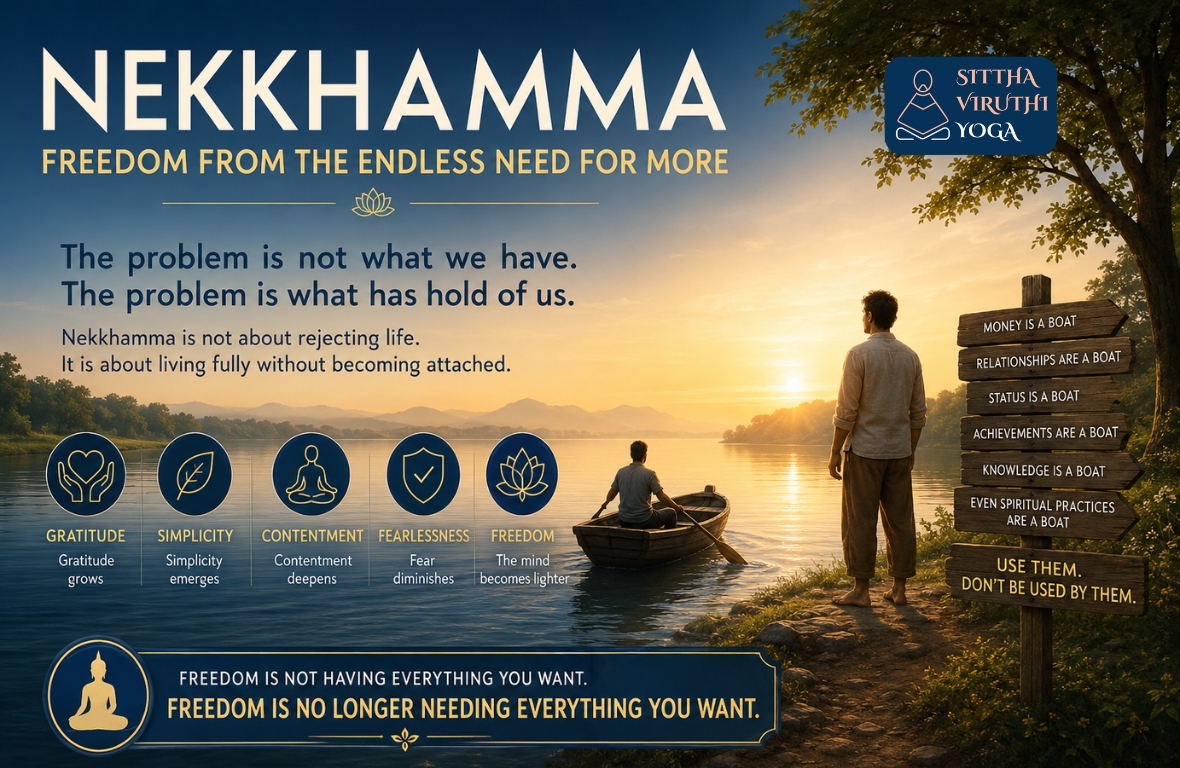
Imagine a man who wishes to cross a river. A boat helps him cross safely. After reaching the other shore, what would a wise person do? He would thank the boat and continue his journey. But what if he thought: "This boat helped me so much. From now on, I will carry it on my head wherever I go." We would immediately recognize the absurdity. The value of the boat lies in helping us cross the river. Not in becoming a burden we carry forever. Much of human suffering arises from making this very mistake. Money is a boat. Relationships are a boat. Status is a boat. Achievements are a boat. Knowledge is a boat. Even spiritual practices are a boat. All of them can help us move through life. All of them have value. But they were meant to serve us, not enslave us. Nekkhamma does not ask us to throw the boat away. It asks us not to carry it on our heads.
Why Is Nekkhamma Important?
Modern society constantly whispers the same message: "You will be happy when you get a little more."
- A larger house.
- A better position.
- More money.
- More recognition.
- More experiences.
The mind keeps moving toward the next destination. As a result, many people never truly live in the present. They live in anticipation of a future that never arrives. The inner dialogue often sounds like this: "I will finally be happy when..." And once that goal is achieved, another immediately appears. The finish line keeps moving. The wanting never ends. This endless pursuit is not merely exhausting. It prevents us from appreciating what is already here. It robs us of contentment. It steals our peace.
The Abhidhamma Insight
The Buddha's analysis of suffering goes much deeper than external circumstances. According to the Abhidhamma, suffering is not created by objects themselves. Objects are simply objects. What creates suffering is the mental process that develops around them. A pleasant experience arises. Craving follows. Craving becomes attachment. Attachment creates dependence. Dependence creates fear. Fear gives rise to suffering. The object is not the problem. The attachment is. Money is not suffering. Attachment to money is suffering. Relationships are not suffering. Clinging to relationships is suffering. Recognition is not suffering. The fear of losing recognition is suffering. The world does not bind us. Our attachment to the world binds us. This is one of the most liberating insights in Buddhist psychology. The problem is not what we have. The problem is what has hold of us.
How Nekkhamma Transforms Us
As attachment begins to weaken, something remarkable happens. Gratitude grows. Simplicity emerges. Contentment deepens. Fear begins to diminish. The mind becomes lighter. An inner spaciousness develops. Life itself may remain exactly the same. The same house. The same family. The same work. The same possessions. Yet everything feels different because the mind's relationship to them has changed. Instead of clinging, there is appreciation. Instead of dependence, there is gratitude. Instead of fear, there is freedom. This is the gift of Nekkhamma. It does not take life away from us. It allows us to experience life more fully.
Conclusion
Dāna taught us how to let go. Sīla taught us how to live. Nekkhamma teaches us another profound lesson. The problem is not what we have. The problem is what has hold of us. Enjoy life. Value relationships. Use possessions. Celebrate achievements. But do not become their prisoner. Because: Freedom is not having everything you want. Freedom is no longer needing everything you want. The more we understand this truth, the more we discover a contentment that does not depend on circumstances. And in that contentment, a deeper clarity begins to emerge.
In the Next Article
As the noise of endless craving begins to quieten, the mind becomes less agitated. For the first time, it begins to see more clearly. Truths that were previously hidden beneath layers of desire, fear, and attachment gradually reveal themselves. This capacity to see things as they truly are lies at the heart of the next Pāramī. In the next article, we will explore Paññā—Wisdom, the perfection of clear seeing and deep understanding.