Mettā: The Heart That Wishes Well for All Beings

A Continuation from the Previous Article
In the previous article, we explored Adhiṭṭhāna, the eighth of the Ten Pāramīs. Adhiṭṭhāna taught us that true determination is not stubbornly clinging to one method, but steadfastly remaining committed to a worthwhile purpose. Through Ananya's story, we discovered that wisdom sometimes asks us to change our path while remaining faithful to our purpose. We concluded with two important insights: A decision chooses the direction. Adhiṭṭhāna keeps us moving in that direction. And, True determination does not mean never changing the path. It means never abandoning what is truly worth pursuing. But after developing wisdom, effort, patience, truthfulness, and determination, another important question naturally arises. Who is all this inner growth for? Is it only for our own peace? Or should our inner growth become a source of well-being for others? This question leads us naturally to the ninth Pāramī: Mettā — the cultivation of unconditional goodwill toward all beings.
Ravi's Story
Ravi had been working in the same company for several years. One morning, a young employee joined the office. The newcomer looked nervous. He spoke hesitantly. He made mistakes. He took longer than everyone else to complete even simple tasks. Some colleagues became impatient. Some laughed quietly among themselves. Others simply ignored him. Ravi watched all this without saying much. He remembered his own first weeks in that very office many years earlier. He remembered how confused he had been. He remembered forgetting procedures, making embarrassing mistakes, and wondering whether he truly belonged there. He also remembered one senior colleague who had patiently guided him without ever making him feel foolish. That memory stayed with him. So Ravi quietly began helping the new employee. He explained procedures patiently. Corrected mistakes without humiliation. Encouraged him whenever he became discouraged. He never expected thanks. He never spoke about his kindness to others. Months passed. The young employee gradually became confident. His work improved. One evening someone asked Ravi, "Why did you spend so much time helping him?" Ravi smiled. "Years ago someone did the same for me." Without realizing it, Ravi had become part of a quiet chain of kindness. Nothing extraordinary had happened. No great sacrifice. No heroic act. Just one human being choosing not to increase another person's suffering. This is Mettā.
What Is Mettā?
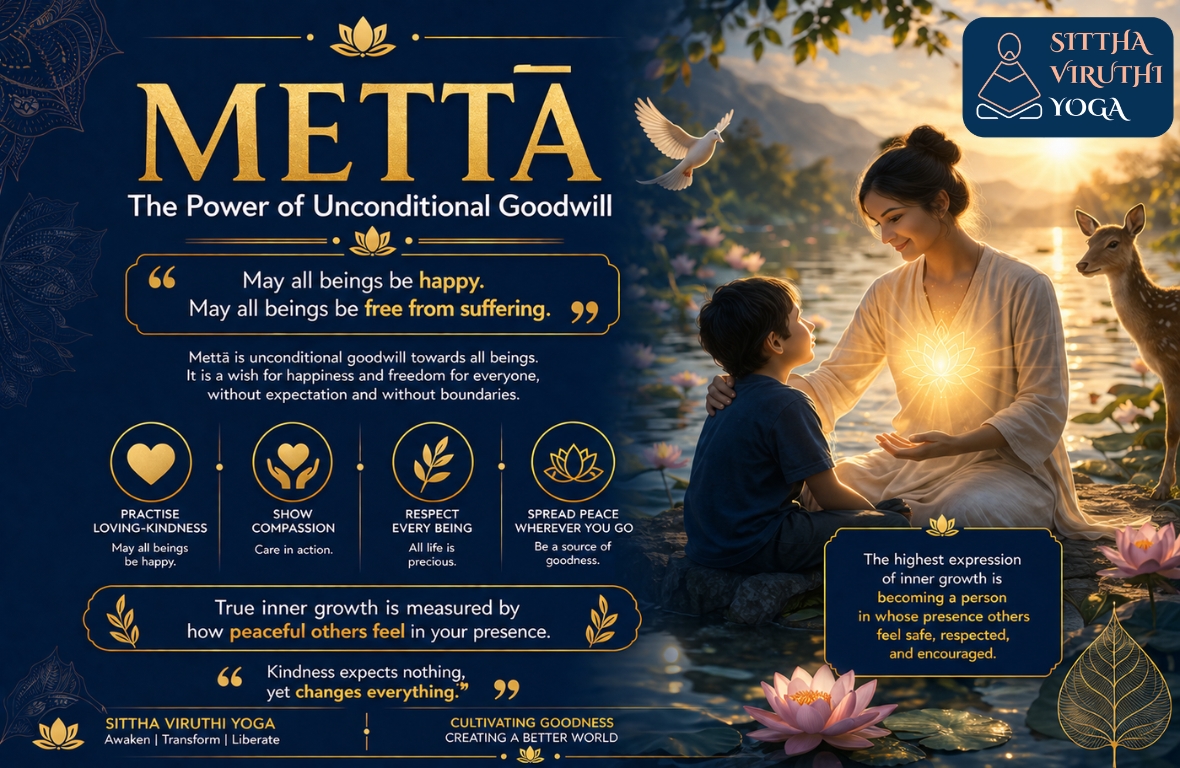
Mettā is often translated as loving-kindness. While this translation is helpful, it can sometimes be misunderstood. Mettā is much more than a pleasant emotion or affection. It is a deliberate way of relating to life. It is the sincere wish: "May this being be well." Not because they belong to us. Not because they agree with us. Not because they deserve our approval. Simply because they, like us, seek happiness and wish to be free from suffering. Mettā is the conscious cultivation of a heart that wishes well for all beings without expecting anything in return. Notice the word cultivation. Just as a seed does not become a tree overnight, goodwill grows through repeated practice. It becomes part of our character.
Why Is Mettā Important?
Knowledge can make us intelligent. Discipline can make us successful. Determination can make us achieve great things. But without goodwill, these qualities can easily become self-centred. A brilliant mind without kindness may become manipulative. A disciplined person without compassion may become harsh. A determined person without goodwill may pursue success while leaving others wounded. Mettā gives direction to all the qualities we have cultivated so far. It reminds us that genuine inner growth naturally expresses itself in the way we relate to others.
The Garden
Imagine a gardener caring for a beautiful garden. The gardener waters every healthy plant. Not only the tallest ones. Not only the most colourful flowers. Not only the plants that produce fruit. Every plant receives care because life itself is valuable. The gardener understands that growth cannot happen without nourishment. Mettā is like that gardener. It does not ask, "Who deserves my goodwill?" Instead, it asks, "How can I avoid adding unnecessary suffering to this world?" Goodwill is offered not because someone has earned it, but because every being longs for happiness.
What Mettā Is Not
Many people confuse Mettā with attachment. They are not the same. Mettā is not possessiveness. It is not emotional dependency. It is not pleasing everyone. It is not weakness. A person with Mettā can still say "No." They can establish healthy boundaries. They can correct mistakes. They can make difficult decisions. But even while doing so, they do not lose their goodwill. They oppose harmful actions without hating the person. This is one of the deepest expressions of Mettā.
The Deeper Perspective of the Abhidhamma
From the perspective of the Abhidhamma, wholesome mental qualities arise together and support one another. One of the beautiful mental factors is Adosa, often translated as non-hatred or absence of ill will. Mettā naturally grows wherever Adosa is present. Notice something remarkable. The Abhidhamma does not define Mettā by emotional excitement. Instead, it begins with the absence of hostility. When the mind is free from the urge to harm, reject, or resent another being, goodwill naturally begins to emerge. This does not mean we must like everyone. Nor does it mean we must agree with everyone. Rather, it means we no longer wish suffering upon them. Paññā helps us see clearly. Viriya gives us the energy to practise. Khanti allows us to endure difficulties. Saccā keeps us aligned with truth. Adhiṭṭhāna keeps us steadfast. Mettā ensures that all these qualities become a blessing not only to ourselves but also to everyone whose life we touch.
Measuring Inner Growth
People often ask, "How do I know whether I am growing?" One answer is surprisingly simple. Observe how people feel after interacting with you. Do they feel respected? Do they feel encouraged? Do they feel understood? Do they feel safe enough to be themselves? Perhaps the measure of inner growth is not how peaceful we feel while sitting alone in meditation. Perhaps it is how peacefully others feel in our presence.
How Mettā Transforms Us
As Mettā deepens, something beautiful begins to happen. Judgment becomes understanding. Competition becomes appreciation. Resentment becomes forgiveness. Fear becomes openness. Separation gradually gives way to connection. The world outside may remain the same. But the heart relating to that world becomes different. Instead of asking, "What can I gain?" We begin asking, "How can I contribute?" Without effort, kindness becomes natural. Without display, goodness becomes ordinary.
Conclusion
Dāna taught us to let go. Sīla taught us to live rightly. Nekkhamma taught us freedom from unhealthy attachment. Paññā taught us to see clearly. Viriya taught us to persevere. Khanti taught us patience. Saccā taught us to live truthfully. Adhiṭṭhāna taught us to remain steadfast in what is worthwhile. Now Mettā teaches us something equally profound. The highest expression of inner growth is becoming a person in whose presence others feel safe, respected, and encouraged. When goodwill becomes our natural way of relating to life, our personal growth is no longer limited to ourselves. It quietly becomes a source of peace for everyone around us. Like Ravi, we become part of an unseen chain of kindness, passing forward the goodness that was once offered to us. This is the quiet power of Mettā.
In the Next Article
A heart filled with goodwill is a beautiful beginning. Yet life continues to present praise and blame, success and failure, gain and loss, joy and sorrow. Can our heart remain balanced amidst these changing conditions? Can we care deeply without becoming attached? Can we remain peaceful without becoming indifferent? These questions lead us to the tenth and final Pāramī: Upekkhā — the perfection of equanimity, balance, and impartial wisdom.