Is Knowledge Enough? Why Understanding Without Practice Cannot Transform Life

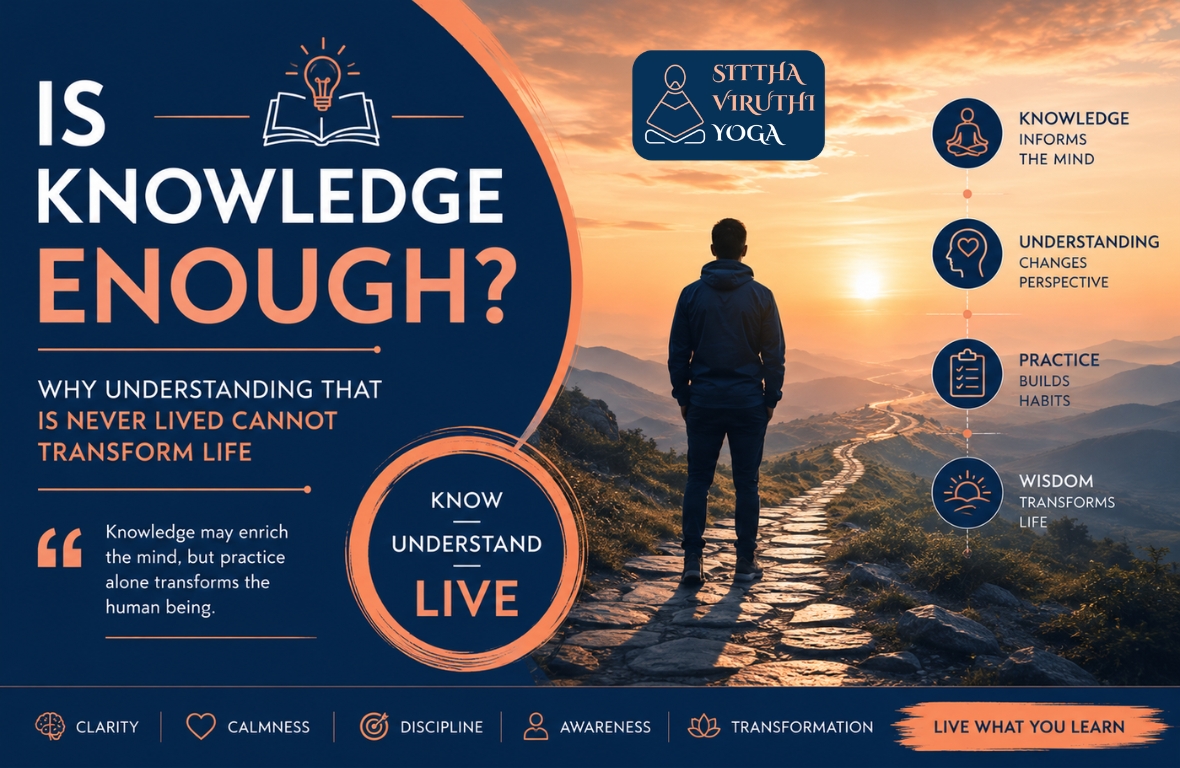
Why Understanding That Is Never Lived Cannot Transform Life
We live in an age overflowing with information. Books, videos, podcasts, lectures, courses, spiritual talks, and psychological explanations are available everywhere. Never before have human beings had such easy access to knowledge. Yet a deeper question continues to disturb modern life:
Why are people still anxious, restless, emotionally reactive, and internally confused despite knowing so much? Why is knowledge increasing, but inner peace is not? Why do people speak endlessly about transformation while remaining fundamentally unchanged? The answer may be subtle, but it is profoundly important: Many times, we collect knowledge — but never allow it to become life.
Knowing Is Different from Living
Talking about meditation is easy. Actually sitting quietly and observing one’s mind daily is difficult. A person may know countless theories about patience and emotional regulation. But true understanding is revealed only when someone insults them and they still respond with awareness instead of unconscious anger. Listening to lectures on discipline is enjoyable. Living with discipline every day is another matter entirely. Real transformation does not happen because of what we know. It happens because of what we consistently live.
The Hidden Pleasure of Intellectual Living
Many people unknowingly become trapped in intellectual living. They continuously:
- Debate Ideas
- Analyze Concepts,
- Compare Philosophies
- Consume Endless Content
- Collect Theories
- and Engage in Stimulating Discussions
All this creates the feeling of growth. But it does not always create actual transformation. Why? Because intellectual engagement itself can become psychologically pleasurable. Complex ideas stimulate the mind. Debates create excitement. Explaining concepts gives a sense of importance and identity. The mind quietly enjoys the feeling: “I know.” Sometimes people even become addicted to intellectual exchange because it provides immediate mental stimulation and pleasant sensations without demanding deep inner effort. Practice is very different.
Why Practice Feels Difficult
Practice is often:- Repetitive
- Slow
- Uncomfortable
- Emotionally demanding
- and sometimes boring
Meditation may initially feel dry. Discipline may feel tiring. Observing one’s emotions honestly may feel painful. Because practice confronts reality directly. It exposes:
- Impatience
- Fear
- Emotional instability
- Unconscious habits
- Attachments
- Distractions
- and Ego
That is why many people remain in the comfort of thinking rather than entering the difficulty of transformation. Theory can keep us in imagination. Practice brings us face to face with ourselves.
When Does Real Understanding Begin?
An important insight from Howard Gardner beautifully explains this difference. He suggests that a person has truly understood something only when they can apply it appropriately in a new real-life situation — not merely repeat it from memory. In simple words: Real understanding is not proven by what we can repeat, but by what we can intelligently apply in life.
The Driving Example
A person may memorize every traffic rule perfectly. But true understanding is revealed when:
- it starts raining
- traffic becomes chaotic
- or an unexpected problem appears
and the person still drives calmly, safely, and wisely. At that moment, knowledge becomes usable intelligence.
Anger Management — The Real Test
Someone may know many theories:
- Stay calm
- Do not react emotionally
- Observe your sensations
But real understanding appears only when:
- anger arises
- emotions intensify
- somebody insults them
and they are still able to observe themselves consciously instead of exploding unconsciously. That is understanding in action. That is lived wisdom.
Memorization Is Not Understanding
Today many people:
- explain ideas beautifully
- discuss philosophy intelligently
- and speak convincingly about transformation
Yet they struggle to apply those insights in ordinary life. That is why:
- information alone is not enough
- knowledge alone is not enough
- intellectual thinking alone is not enough.
Theory and Practice Must Go Hand in Hand
This does not mean theory is useless. Theory is essential. It gives direction. It clarifies mistakes. It deepens understanding. But theory without practice becomes lifeless abstraction. And practice without understanding becomes blind repetition. A doctor cannot become skillful through textbooks alone. A musician cannot master music merely by studying theory. Likewise, wisdom cannot emerge through intellectual accumulation alone. Theory and practice must walk together. One gives clarity The other gives transformation.
Small Practice, Deep Change
Even a few minutes of sincere daily practice can slowly reshape a human being. A few minutes of:
- self-observation
- meditation
- emotional awareness
- gratitude
- disciplined action
- mindful communication
- or conscious silence
can gradually transform the mind, habits, relationships, and inner life. Real growth is usually quiet. Like a seed becoming a tree, transformation often happens invisibly before becoming visible. Modern culture glorifies stimulation.
But wisdom grows through:
- Consistency
- Patience
- Humility
- and Lived Experience
The True Purpose of Knowledge
The purpose of knowledge is not merely to impress others. It is to transform oneself. To become calmer. Clearer. Kinder. More aware. True wisdom is not measured by:
- how much a person speaks
- how many books you have read
- or how intelligently they can debate
It is measured by how consciously they live. At the end of life, the real question is not: “How much did you know?” But rather:
- How deeply did you understand yourself?
- How consciously did you live?
- How compassionately did you treat others?
- How sincerely did you practice what you claimed to value?