Khanti: The Wisdom of Allowing Growth to Unfold in Its Own Time

A Continuation from the Previous Article
In the previous article, we explored Viriya, the fifth of the Ten Pāramīs. We saw that Viriya is not merely hard work. It is the steady, mindful, and purposeful effort required for inner transformation. Wisdom shows the path. Viriya enables us to walk it. But once we begin walking the path, a new challenge emerges. Transformation does not happen immediately. Results do not arrive as quickly as we would like. Sometimes we make sincere efforts but see little progress. Sometimes life does not cooperate with our plans. Sometimes we become disappointed with ourselves. At that point, a new question arises:
How do we remain balanced when growth does not unfold according to our expectations?
The answer lies in the sixth Pāramī: Khanti.What Is Khanti?
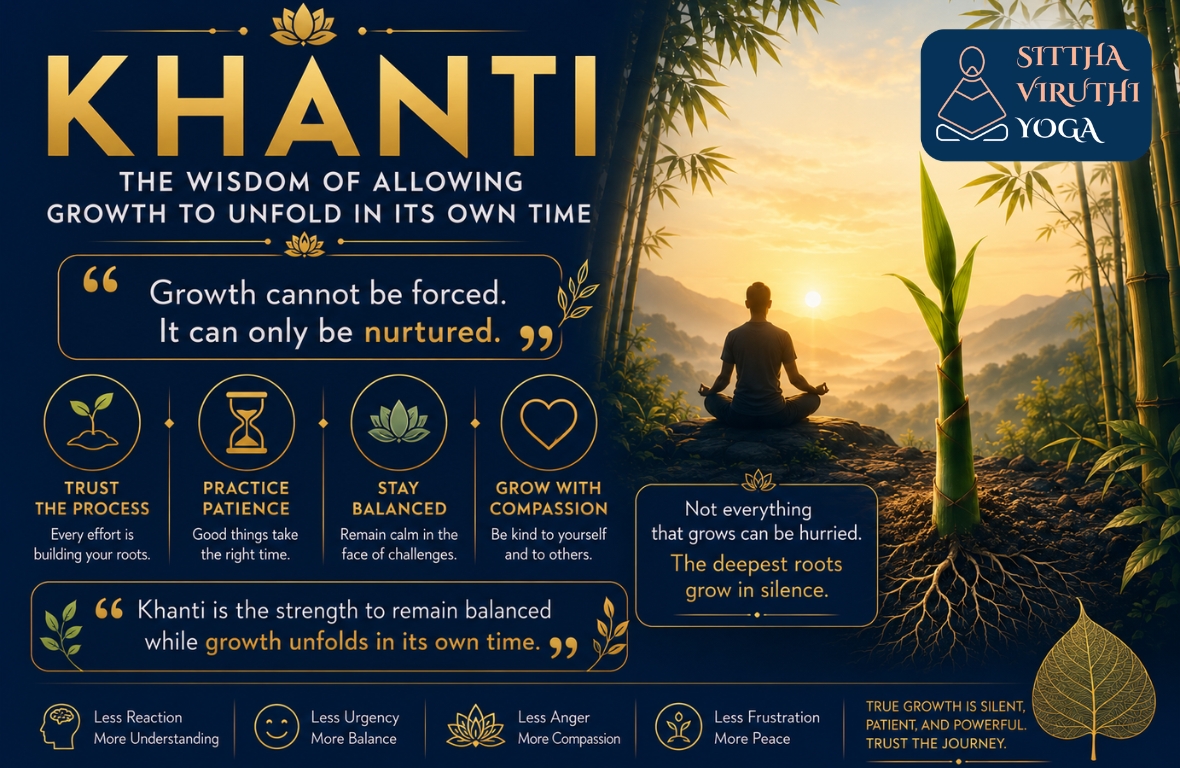
Khanti is often translated as patience. But Khanti is much more than simply waiting. It is not passive endurance. It is not weakness. It is not resignation. Khanti is: The strength to remain balanced in the face of difficulty, delay, disappointment, discomfort, and resistance. Khanti is the ability to live without forcing life. It is the maturity to stop trying to rush growth.
Simply put: Khanti is the strength to remain steady while growth unfolds in its own time.Why Is Khanti Important?
We live in an age that values speed. Instant information. Instant communication. Instant entertainment. Instant service. Gradually, the mind becomes accustomed to receiving everything quickly. As a result, we begin to expect life itself to move at the same pace. But life does not work that way. A seed does not become a tree overnight. A relationship does not deepen overnight. A wound does not heal overnight. A human being does not mature overnight. Inner transformation does not happen overnight. When we resist this reality, frustration arises. Frustration becomes irritation. Irritation becomes anger. Anger becomes suffering. Khanti protects us from this unnecessary suffering.
The Lesson of the Bamboo Tree
Certain species of bamboo show very little visible growth for several years after they are planted. Someone observing them might conclude: "Nothing is happening." Yet beneath the surface, an extensive root system is developing. Then, at a certain point, the bamboo begins to grow rapidly. People are amazed by its sudden growth. But that growth did not happen overnight. It was the result of years of unseen preparation. Inner growth is much the same. The efforts we make today may not immediately show visible results. But they are not wasted. They are quietly developing roots within us. Khanti is the ability to trust this process.
When a Child Learns to Walk
Imagine a child learning to walk for the first time. The child stands up. Takes a few steps. Falls down. Gets up again. Falls again. Repeats this process countless times. Yet no loving parent says: "Why can't you walk properly yet?" Because they understand a simple truth: Learning to walk takes time. Growth takes time. Skill takes time. Maturity takes time. Yet surprisingly, we often fail to extend this same understanding to ourselves. We try to change a habit. We fail a few times. Immediately we begin criticizing ourselves. Khanti reminds us: Just as a child learns to walk gradually, the mind also grows gradually. It needs time. It needs effort. And it needs patience.
The Deeper Perspective of the Abhidhamma
The Abhidhamma examines the mind with remarkable precision. When unpleasant experiences arise, the mind often reacts automatically. Irritation appears. Resistance appears. Anger appears. Impatience appears. Frustration appears. These reactions increase suffering. The Abhidhamma speaks of Adosa (non-hatred), which is closely related to Khanti. Khanti is not merely the ability to wait. It is the ability to prevent hatred and resentment from taking root in the mind. It is the capacity to preserve inner peace even when circumstances do not unfold according to our wishes. For this reason, Khanti is regarded as a profound inner strength.
How Khanti Transforms Us
Khanti gradually matures a person. It replaces reaction with understanding. It replaces urgency with balance. It replaces anger with compassion. It replaces discouragement with steadiness. Most importantly, it helps us accept that life will not always unfold according to our preferences. This acceptance is not defeat. It is a form of wisdom.
Conclusion
Dāna taught us how to let go. Sīla taught us how to live. Nekkhamma taught us freedom from attachment. Paññā taught us how to see clearly. Viriya taught us how to walk the path. Khanti teaches us how to continue the journey. Because: Not everything that grows can be hurried. And: Khanti is the strength to remain balanced while growth unfolds in its own time. Most profound transformations happen slowly. They cannot be forced. But they can be supported with trust, patience, and perseverance. That is the power of Khanti.
In the Next Article
As patience deepens, we begin to stop fighting with reality. We become more willing to see things as they truly are. And then a new question arises: Am I living in alignment with truth? This question leads us naturally to the next Pāramī: Sacca — Truthfulness, integrity, and the art of living in harmony with truth.