“I’ll Remember…” Maravi — When Good Intentions Are Not Enough

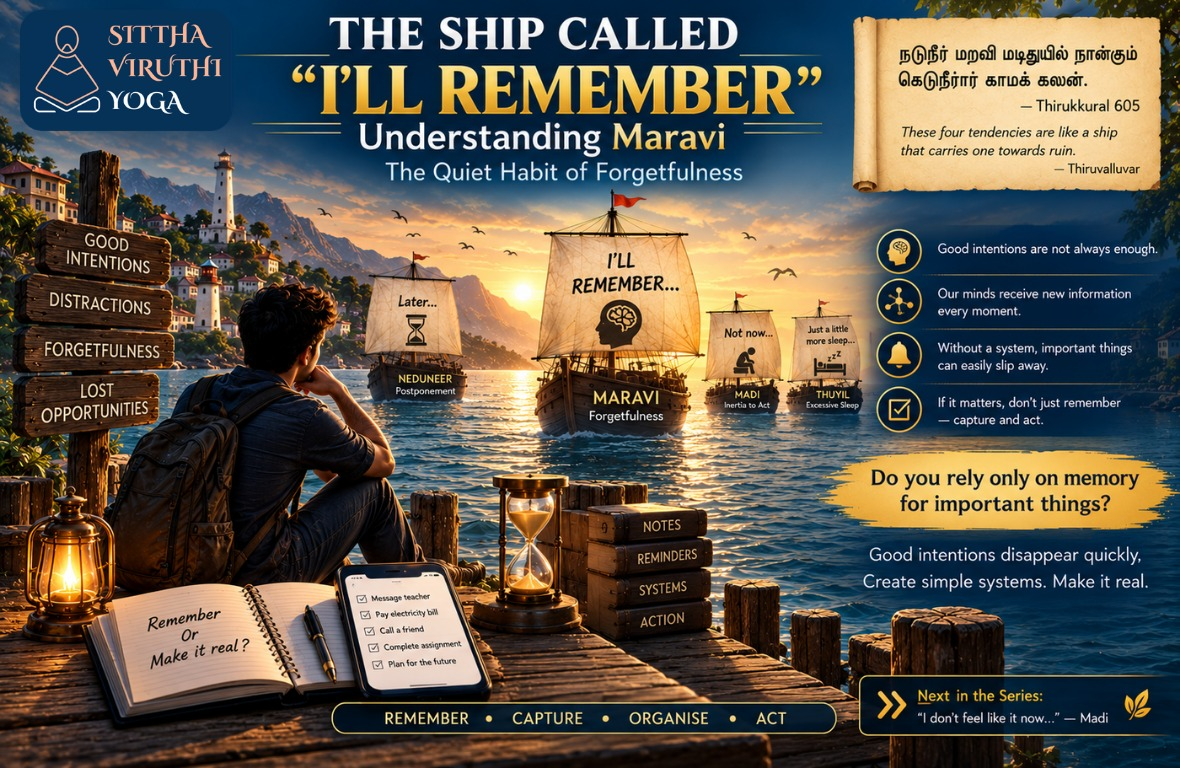
“Neduneer maravi madi thuyil naangum
Keduneerar kaamak kalan.”— Thirukkural 605
In the previous article, we explored the first of the four ships identified by Thiruvalluvar: Neduneer — postponement.
We saw how an apparently harmless sentence—
“I’ll do it later…”
—can quietly move an important action from the present into an uncertain future.
Arun had found a valuable training programme.
He genuinely wanted to apply.
He needed a recommendation from his teacher, but instead of contacting him immediately, he thought:
“There are still ten days. I’ll ask tomorrow.”
A couple of days later, the application came back to his mind.
This time he remembered what needed to be done.
He thought:
“I must message my teacher. I’ll do it as soon as I get home.”
He reached home.
Other things demanded his attention.
And somewhere between remembering and doing... the intention disappeared.
The first ship had whispered:
“Later…”
Now a second ship had quietly arrived:
“I forgot.”
This is Maravi — மறவி.
Good Intentions Are Not Always Enough
Most of us have experienced something like this.
While cooking, we suddenly remember:
“I need to pay the electricity bill.”
Then the phone rings.
Ten minutes later, the thought has disappeared.
A student remembers an important question to ask the teacher.
“I’ll ask during class.”
The class begins.
The question is forgotten.
We meet a friend and suddenly say:
“I’ve been thinking of calling you for the last three months!”
We genuinely meant to call.
But we did not.
This reveals something important:
Intending to do something and creating the conditions for actually doing it are not the same thing.
A good intention may arise sincerely.
But unless that intention is translated into some form of action, it can disappear as quickly as it appeared.
“I’ll Remember”
There is a small sentence many of us use with great confidence:
“I’ll remember.”
Someone tells us an important date.
“I’ll remember.”
We realise that something must be purchased.
“I’ll remember.”
A task comes to mind.
“I’ll remember.”
We promise ourselves to make a phone call.
“I’ll remember.”
But our minds are continuously receiving new information.
Conversations.
Messages.
Responsibilities.
Emotions.
Notifications.
Unexpected events.