Dhana — When Giving Becomes Inner Growth

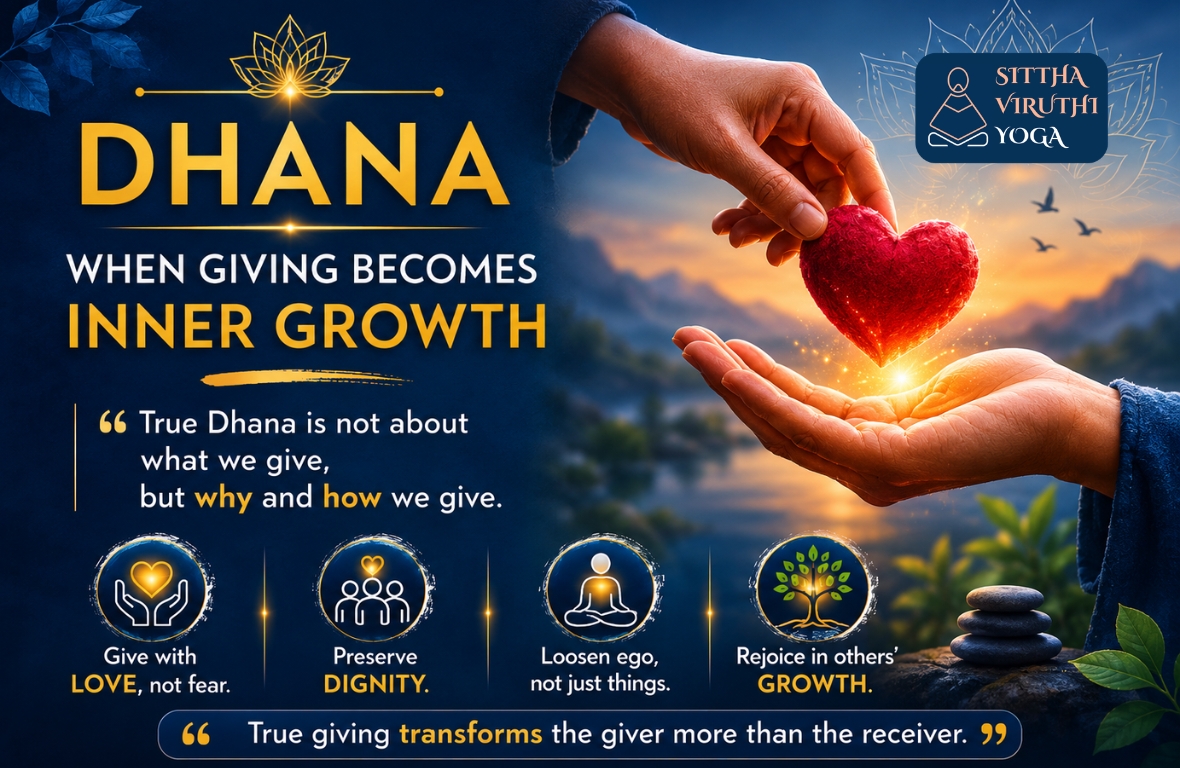
Among the Ten Paramis, Dhana is placed first. This is not accidental. Before wisdom deepens, before meditation matures, before compassion flowers fully, something fundamental within a human being has to soften — the tight grip of “me” and “mine.” Human beings naturally accumulate.
Not only wealth, but also:- Possessions
- Status
- Recognition
- Opinions
- Emotional wounds
- Relationships
- Identities
- Psychological security
- My success
- My family
- My image
- My achievements
- My safety
And without realizing it, what we hold tightly begins to hold us. Dhana is not merely about giving things away. It is about loosening the inner contraction created by possessiveness. Real generosity does not reduce our life. It expands our consciousness.
When Giving Comes from Ego
Society often celebrates acts like offering food at orphanages or old age homes during birthdays, anniversaries, or wedding celebrations. Such acts are generally seen as noble and compassionate. But if we observe deeply, an important question arises: What is the psychological state from which we are giving? Sometimes, charity may unknowingly arise not from love, but from:
- Fear
- Guilt
- Social image
- Emotional satisfaction
- Spiritual bargaining
- Subtle superiority
- Nothing bad should happen to their family
- Their children should prosper
- Life should go smoothly
- Blessings should come in return
Outwardly the action may appear generous. But inwardly, fear may be operating silently.
As Osho once said: “Move the way love makes you move, not the way fear makes you move.” This insight invites deep reflection. Because intention shapes the psychological quality of an action.
The Invisible Wound
There are situations where charity unknowingly harms the dignity of the receiver. For example, in some orphanages, children are made to wait until donors arrive before they are allowed to eat. Sometimes they are expected to sing, bless the donor’s family, smile gratefully, or publicly praise the generosity of the giver before receiving food. Only then are they permitted to eat. But our own children at home are never asked to earn their meal through gratitude ceremonies.
- They eat with freedom
- With dignity
- With belongingness
Whether the children in such institutions truly feel comfortable or not, dependency often leaves them with little choice. Slowly, a subtle message may enter the mind: “You are receiving because someone above you is giving.” Externally this may appear harmless. But internally, repeated experiences of psychological inferiority can silently wound self-respect. This does not mean charity itself is wrong. Nor does it mean orphanages or social service institutions should not be supported. The real question is deeper: Can help be offered without injuring dignity? Because true compassion should empower human beings, not psychologically reduce them.
Dhana Is Not Disposal
Another important dimension of conscious giving is often overlooked. Many times, people donate:
- Old clothes
- Damaged furniture
- Unusable utensils
- Broken cycles
- Worn-out cots
- Outdated appliances
- Objects lying unused for years in storage rooms
Not necessarily because those things are genuinely useful to someone else, but because they themselves no longer want them. In such situations, charity unconsciously becomes a method of disposal. The giver feels relieved. But the receiver may silently inherit inconvenience, repair costs, embarrassment, or burden. True Dhana is not about emptying our storage spaces. It is about caring for another human being. Before giving something, perhaps we should ask ourselves:
“Would I happily use this myself? Would I respectfully offer this to my own child or family member?”If the answer is no, then perhaps what we are offering is not generosity, but psychological distancing. Real giving contains sensitivity. What is given should be:
- Clean
- Functional
- Dignified
- Readily usable
Because dignity matters as much as generosity.
The Subtle Pleasure of Being “The Giver”
Sometimes, generosity may unknowingly become part of our identity. The mind begins to enjoy being:
- The Helper
- The Rescuer
- The Provider
- The one standing in a higher position
In such cases, giving subtly strengthens the ego instead of dissolving it. A simple way to observe this is through an inward question: “If one day every human being becomes self-reliant, dignified, fulfilled, and no one remains dependent on my help — would my heart feel pure joy?”
If the answer creates discomfort, then perhaps the mind is not merely enjoying compassion, but also the psychological importance attached to being “the giver.” When Dhana arises from love, we genuinely wish for a world where no human being is forced into helplessness. But when giving unconsciously arises from ego, the mind may silently need inequality to continue — because the identity of being superior depends upon someone remaining in an inferior position. True Dhana does not seek psychological elevation through another person’s struggle. It rejoices when the other person becomes equally strong, free, and independent.
The Receiver Also Gives
There is another beautiful truth that is rarely understood. We often think the receiver should feel grateful to the giver. But perhaps the giver too should feel grateful. Because someone’s willingness to receive allows the heart to experience the joy of giving. Without someone to receive, even generosity would remain incomplete. The receiver may appear to accept the offering externally, but inwardly they are also giving the giver an opportunity:
- To soften greed
- To Loosen ego
- To Cultivate compassion
- To grow as a human being
When this understanding flowers, superiority disappears. Giving becomes humble. Silent. Respectful.
The Deep Purpose of Dhana
The deepest purpose of Dhana is not social appreciation. It is inner transformation. When giving happens consciously:
- Greed weakens
- Fear Softens
- Possessiveness reduces
- Ego loosens
- Compassion becomes natural
The giver is transformed more than the receiver. That is why Dhana comes first among the Paramis. A closed fist cannot receive truth. As long as the mind remains trapped in selfishness, accumulation, and superiority, spiritual growth becomes difficult. Real generosity slowly dissolves the walls created by the ego. And perhaps true Dhana begins not when something leaves our hand — but when superiority leaves our mind. Because Dhana is not about making ourselves feel important. It is about learning to see another human being as equal to ourselves.