Ahimsa is not merely the absence of violence. It is the presence of love, compassion, and understanding.
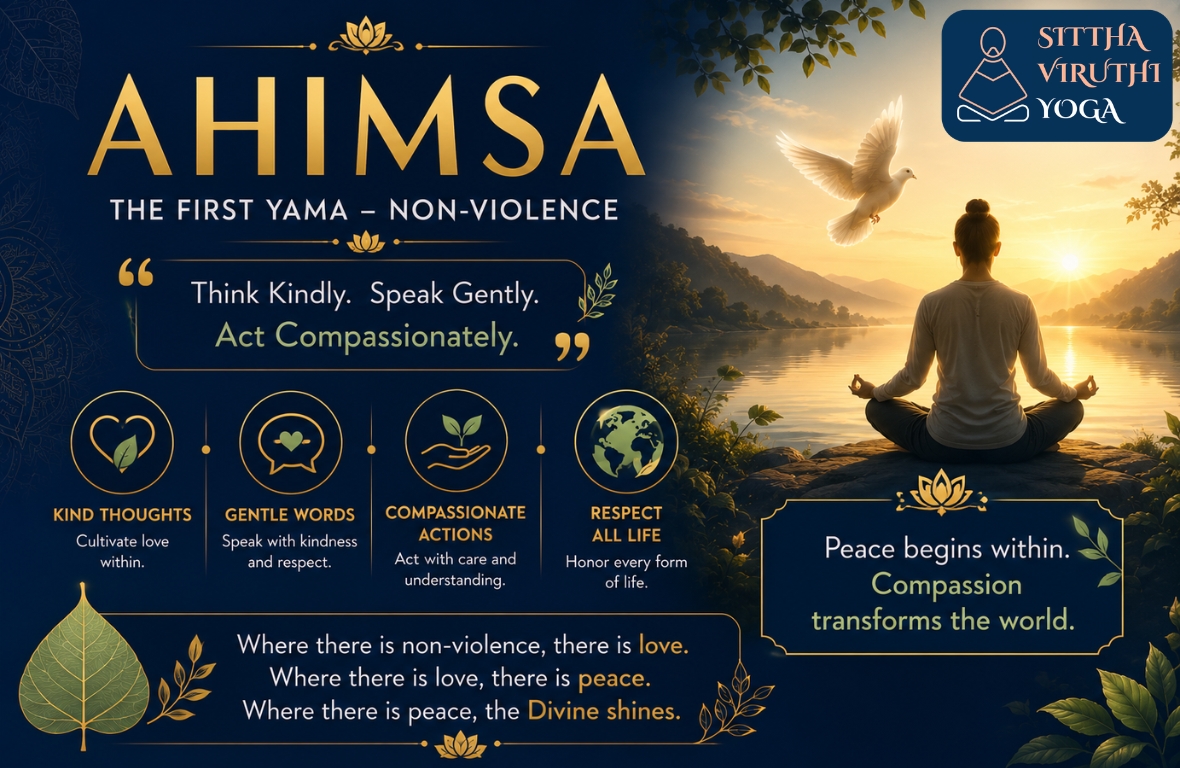
The first Yama described by Sage Patanjali is Ahimsa—the noble principle of non-violence in thought, word, and action.
Ahimsa begins within us.It is not enough to avoid hurting others physically. True Ahimsa means:
- Thinking kindly.
- Speaking gently.
- Acting with compassion.
- Respecting all forms of life.
When our mind is free from anger, hatred, jealousy, and revenge, peace naturally blossoms within us. A peaceful mind creates peaceful relationships, and a peaceful society begins with a peaceful individual.
Patanjali says:
“Ahimsa Pratishthayam Tat Sannidhau Vaira Tyagah.” “When one is firmly established in Ahimsa, all hostility ceases in their presence.” — Patanjali, Yoga Sutra II.35
Such is the power of true non-violence. The presence of a person established in Ahimsa radiates harmony, dissolving conflict without force.
How does Sittha Viruthi Yoga cultivate Ahimsa?
At Sittha Viruthi Yoga, Ahimsa is practised as a way of life. Through meditation, self-awareness, disciplined living, and spiritual wisdom, participants gradually transform negative emotions into love, patience, forgiveness, and compassion.
As the mind becomes calm, our thoughts become pure, our words become kind, and our actions become a blessing to others.
A Thought to Reflect On“Peace does not begin in the world. It begins in the human heart.” This week, let us consciously practise Ahimsa— one kind thought, one gentle word, and one compassionate action at a time. 🌿 The journey of Yoga begins with Ahimsa, for where there is non-violence, there is love; where there is love, there is peace; and where there is peace, the Divine shines.