Adhiṭṭhāna: The Determination to Never Abandon What Truly Matters

A Continuation from the Previous Article In the previous article, we explored Saccā, the seventh of the Ten Pāramīs. Saccā revealed an important truth: Truth does not create reality. Truth reveals reality. We understood that genuine transformation begins only when we honestly acknowledge our anger, fear, greed, attachment, and ego instead of hiding from them. Because: Transformation begins the moment we stop pretending. But is seeing the truth alone enough? Does merely knowing what is right transform our lives? No. Knowing the truth is one thing. Continuing to live in alignment with that truth is another. What happens when life becomes difficult? When obstacles arise? When enthusiasm fades? When the path we have chosen no longer seems to work? What do we do then? This question leads us to the eighth Pāramī: Adhiṭṭhāna — determination and unwavering resolve.
Ananya's Story
Ananya lived in a small town. She had a simple but deeply meaningful aspiration. She wanted to teach children from economically disadvantaged families in her neighbourhood, free of charge. She rented a small space on weekends. Bought a few books. Prepared her lessons. On the first day, she expected ten children to arrive. Three came. The following week, two came. The week after that, only one. After a few weeks, no one came at all. That day, Ananya sat alone in the empty room. The chairs remained vacant. The lessons she had carefully prepared lay untouched on the table. Time passed. No one came. For the first time, a question arose within her: "Is there any point in continuing this?" For a moment, she felt like giving up everything. Perhaps the children simply weren't interested. Perhaps her effort was unnecessary. Perhaps she had failed. The disappointment was real. The doubt was real. But after some time, she told herself: "I am determined. I will not give up." So she continued holding classes in the same place, at the same time, in exactly the same way. But nothing changed. She had not given up. Yet there was still something important she had not understood: Simply refusing to give up is not always determination. Sometimes, it can become stubbornness. One day, an elderly woman from the neighbourhood asked her: "Have you ever asked the children why they aren't coming?" Ananya fell silent. She had never asked that question. She had expected the children to come. But she had never tried to understand why they could not. Over the next few days, she met the children and their parents. Then she discovered the truth. Many of the children had to help their parents with work on weekends. For some, the place where she held the classes was too far away. Some children were willing to attend immediately after school. Then Ananya understood something important. Her purpose was not wrong. But her method was not working. She changed the class timings. She began conducting classes closer to where the children lived. On some days, she went directly to their homes. Gradually, the children began to come. Three. Five. Ten. Ananya did not change her purpose. But she changed her path. And then she understood: Determination is not clinging to one path. It is refusing to abandon a truly worthwhile purpose. This is Adhiṭṭhāna.
What Is Adhiṭṭhāna?
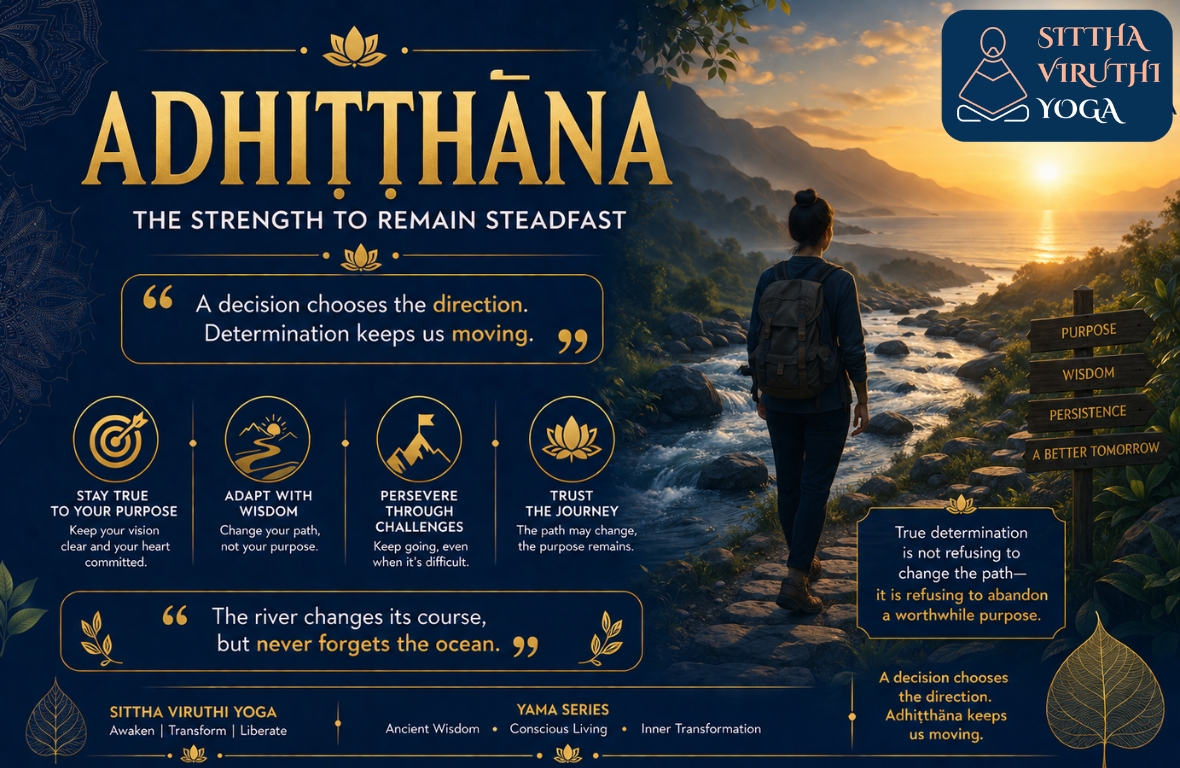
Adhiṭṭhāna is commonly understood as determination, resolution, or unwavering strength of mind. But it is not mere stubbornness. Stubbornness says: "I have made my decision. Whatever happens, I will never change." Adhiṭṭhāna says: "Having clearly understood what is truly worthwhile, I will not abandon it when difficulties arise." There is a profound difference between the two. Stubbornness may reject wisdom. Adhiṭṭhāna is guided by wisdom. Stubbornness may continue even on the wrong path. Adhiṭṭhāna remains steadfast in what is wholesome. Simply put: A decision chooses the direction. Adhiṭṭhāna keeps us moving in that direction.
The Lesson of the River
A river journeys toward the ocean. Along its way, it encounters rocks. Obstacles arise. What does the river do? It does not stand before a rock and stubbornly declare: "I must go only this way!" It changes its course. It flows around the rock. Sometimes it moves slowly. Sometimes it moves rapidly. In some places, it even changes direction. But one thing does not change. It never stops its journey toward the ocean. This is Adhiṭṭhāna. The path may change. But a truly worthwhile purpose is not abandoned. Ananya did exactly this. She changed her path. But she did not forget her ocean.
Why Is Adhiṭṭhāna Important?
Many of us make good decisions. We decide to exercise. To live healthily. To reduce anger. To meditate. To develop a valuable skill. To live a meaningful life. But what happens when the initial enthusiasm fades? Within a few days, old habits return. Within a few weeks, effort declines. Within a few months, the decision itself may be forgotten. Often, the problem is not that we do not know what is right. The problem is that we do not continue choosing it. Adhiṭṭhāna bridges this gap.
The Person Who Protects the Lamp
Imagine a person travelling through the night carrying a lamp. The wind blows. Rain falls. Darkness surrounds them. They cannot stop the wind. They cannot control the rain. They cannot remove the darkness. But there is one thing they can do. They can shield the lamp with their hands. Throughout the journey, they protect the flame from going out. Our wholesome intentions are much the same. The winds of life will blow. Difficulties will arise. People may misunderstand us. Enthusiasm may fade. But Adhiṭṭhāna protects the flame of wholesome intention burning within us.
The Deeper Perspective of the Abhidhamma
From the perspective of the Abhidhamma, no action arises without causes and conditions. Behind intention, choice, effort, and action, many mental factors are at work. Among these, Cetanā — volition or intention — is especially significant. Cetanā directs the mind toward action. But the arising of a good intention once is not enough. It must be continuously supported and sustained. This is where Paññā, Viriya, and Adhiṭṭhāna come together. Paññā helps us clearly recognize what is truly worthwhile. Viriya gives us the energy to work toward it. Adhiṭṭhāna enables us to remain steadfast in the wholesome direction even when obstacles arise. Therefore, Adhiṭṭhāna is not blind stubbornness. It is the strength of mind to remain committed to a wholesome path chosen with wisdom. We see the same thing in Ananya's story. Had she blindly clung to her original method, it would have been stubbornness. Instead, she faced the truth, changed her approach, and remained committed to her wholesome purpose. That is determination guided by wisdom.
Making a Decision Is Easy; Remaining Committed Is Difficult
At the beginning of a new year, many people make resolutions. I will exercise. I will meditate. I will reduce my anger. I will learn a new skill. During the first few days, enthusiasm is high. But enthusiasm does not always last. That is when the real question arises: Can I continue even when I no longer feel enthusiastic? Adhiṭṭhāna is not a grand decision made at the height of emotion. It is the inner resolve to choose the same wholesome commitment again and again, even after the excitement has faded.
How Adhiṭṭhāna Transforms Us
Adhiṭṭhāna gradually develops stability within a person. It reduces distraction. It strengthens consistency. It develops inner resolve. It prevents temporary emotions from repeatedly changing the direction of our lives. Most importantly, it teaches us to honour the wholesome promises we make to ourselves. Each time we remain committed to a good decision, our inner reliability grows. Gradually, we begin to trust ourselves.
Conclusion
Dāna taught us how to let go. Sīla taught us how to live rightly. Nekkhamma taught us freedom from attachment. Paññā taught us how to see clearly. Viriya taught us how to walk the path. Khanti taught us how to continue the journey. Saccā taught us how to live in alignment with truth. Adhiṭṭhāna teaches us to remain steadfast and not abandon what is truly worthwhile. Because: A decision chooses the direction. Adhiṭṭhāna keeps us moving in that direction. And: True determination does not mean never changing the path. It means never abandoning what is truly worth pursuing. Ananya changed her path. But she did not abandon her purpose. The river changes its course. But it does not forget the ocean. The paths of life may change. Methods may change. Circumstances may change. But carrying forward a truly worthwhile purpose with wisdom and steadfastness is the power of Adhiṭṭhāna.
In the Next Article
A person may see clearly. They may make effort. They may continue patiently. They may live truthfully. They may remain firmly committed. But one important question still remains: Who is this growth for? Is it only for me? Genuine inner transformation does not separate us from others. It expands the heart. This question leads us naturally to the ninth Pāramī: Mettā — the perfection of loving-kindness and unconditional goodwill toward all beings.